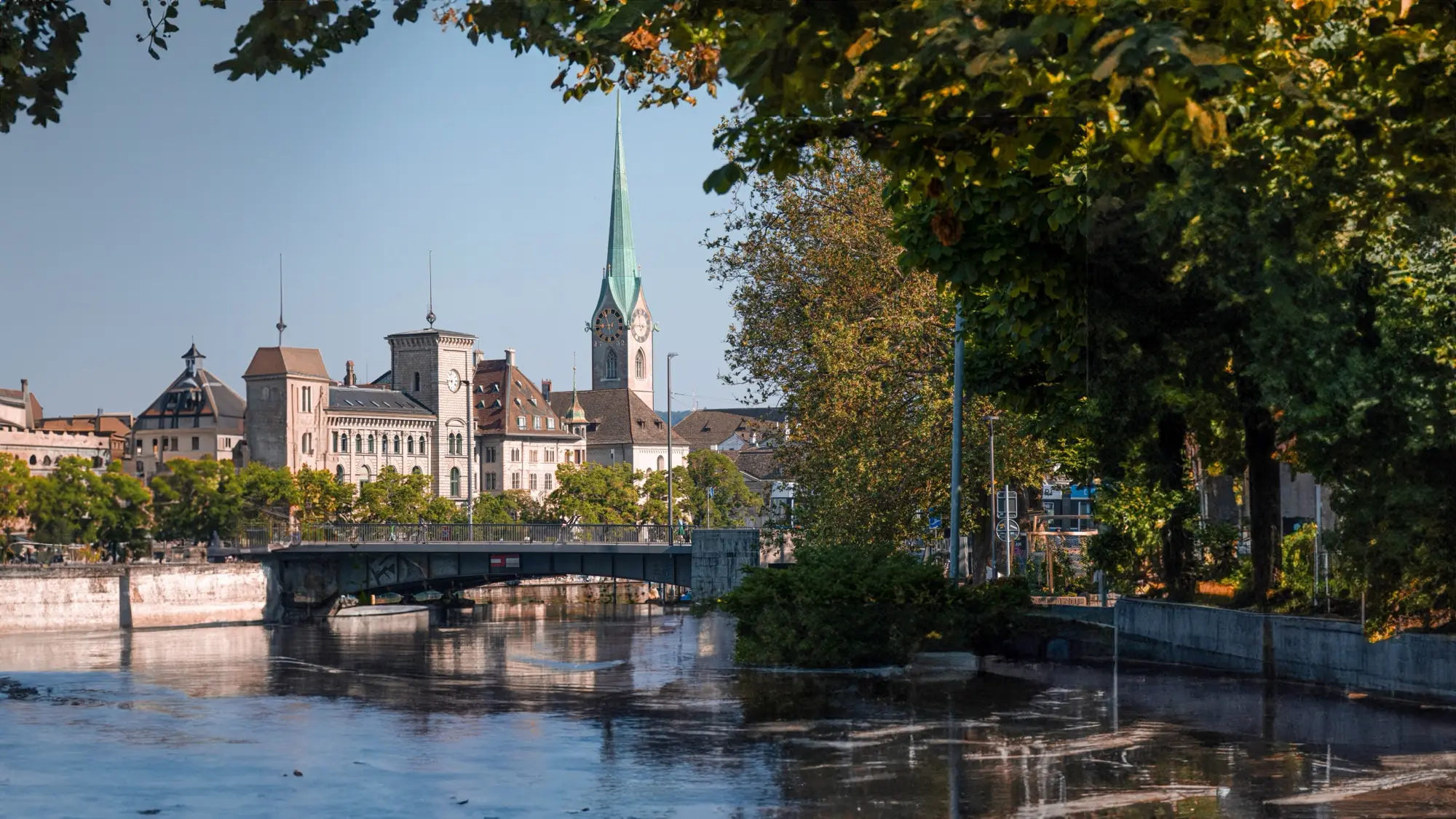
Zurich
January is the calm month and July the full one, with Advent adding a smaller rise at the end of the year.
When to visit Zurich
Zurich is calmest in January and busiest in July. For the best balance of decent weather and smaller crowds, aim for February.
Zurich is a working city before it is a destination, and its crowd curve shows it: no month empties the place, and the range runs from a calm January to a July that is barely ahead of June and August. In January the highs reach 4°C and the lows fall to -1°C; in July the highs reach 24°C and the banks of the lake and the Limmat are in constant use.
Summer is the long peak, from June to September. The Street Parade takes over the lakefront on the second Saturday of August, the Zürcher Theater Spektakel follows in the second half of the month, and September stays busy rather than quiet, with the Knabenschiessen fair on the second weekend and the Zurich Film Festival toward the end of the month. May is the wettest month by rain days, with 13, which is worth knowing when spring weekends look tempting.
The easiest months for a first visit are April, October and November. April and November sit well below the summer figures, with highs of 15°C and 8°C. December rises again with the Christmas market in the main station and only 8 hours of daylight; January to March remain the calmest, and the museums and Old Town lanes are easy to move through on a weekday.
Book things to do
Tours and tickets in Zurich, from our booking partner.
 Free cancellation
 Free cancellation
 Free cancellation
 Free cancellation
 Free cancellation
Crowds month by month
Twelve months of Zurich at a glance — tap a month for the full picture.
Every month in Zurich
Weather, crowds and what’s on — one page per month.
Quietest month: Zurich in January
Weather through the year
Typical highs, lows and wet days.
Best day of the week
How the crowd moves through a typical week.
Tue is normally the calmest day of the week.
Best time of day
The daily rhythm, hour by hour.
The 9:00 AM window is usually the calmest of the day.
Where the crowd gathers
A typical peak afternoon in the centre.
How long to stay
Two days cover the Old Town, the lakefront and a museum or two; a third adds the Uetliberg or a lake boat. Four or five days leave room for day trips by train, since Lucerne is under an hour away.
Local timing tips
- The ZürichCard (24 or 72 hours) covers public transport in the city and the surrounding region, including the airport transfer, plus free entry to many museums such as the permanent collection of the Kunsthaus Zürich, the National Museum and the Museum Rietberg.
- Most museums are closed on Mondays, so use Monday for the lake, the Old Town and the Uetliberg and keep Tuesday to Sunday for exhibitions.
- On legal holidays (1 January, Good Friday, Easter Monday, 1 May, Ascension, Whit Monday, 1 August, 25 and 26 December) most shops, schools and offices close, while restaurants and museums are usually open; on 24 and 31 December most shops close between 16:00 and 18:00.
- On Sechseläuten Monday the guild procession starts in the middle of the afternoon and the Böögg is lit at 6 pm; the area around Sechseläutenplatz is very congested from 5 pm, so arrive early or watch the procession along Bahnhofstrasse.
Where to stay
Outside peak season, nightly rates tend to be lower, and flexible dates help. Compare places to stay on Booking.com.
Frequently asked questions
When is the best time to visit Zurich?
The best time to visit Zurich is January, the quietest month of the year, or the shoulder weeks around February when the crowd eases but the weather still holds.
What is the cheapest and quietest month in Zurich?
January is the quietest month in Zurich, with a modelled crowd level near 39/100 and typical highs of 4°C.
When is Zurich most crowded?
Zurich peaks in July, when both visitor numbers and prices are at their highest.
How many days do you need in Zurich?
Two days cover the Old Town, the lakefront and a museum or two; a third adds the Uetliberg or a lake boat. Four or five days leave room for day trips by train, since Lucerne is under an hour away.
Sources
Weather: 1995–2024 averages from the Zürich-Fluntern weather station (NOAA GHCN-Daily); rain days count days with at least 1 mm.
Monthly crowd index: calculated from recorded overnight stays (table tour_occ_nin2m, 2022–2025; area: canton of Zurich (CH04)), published byEurostat.
Crowd scores are modelled estimates, not live counts.How the model works
Events, holidays and practical notes are checked against these official pages:
Other attractions

Photo: Bryan Dijkhuizen · Pexels