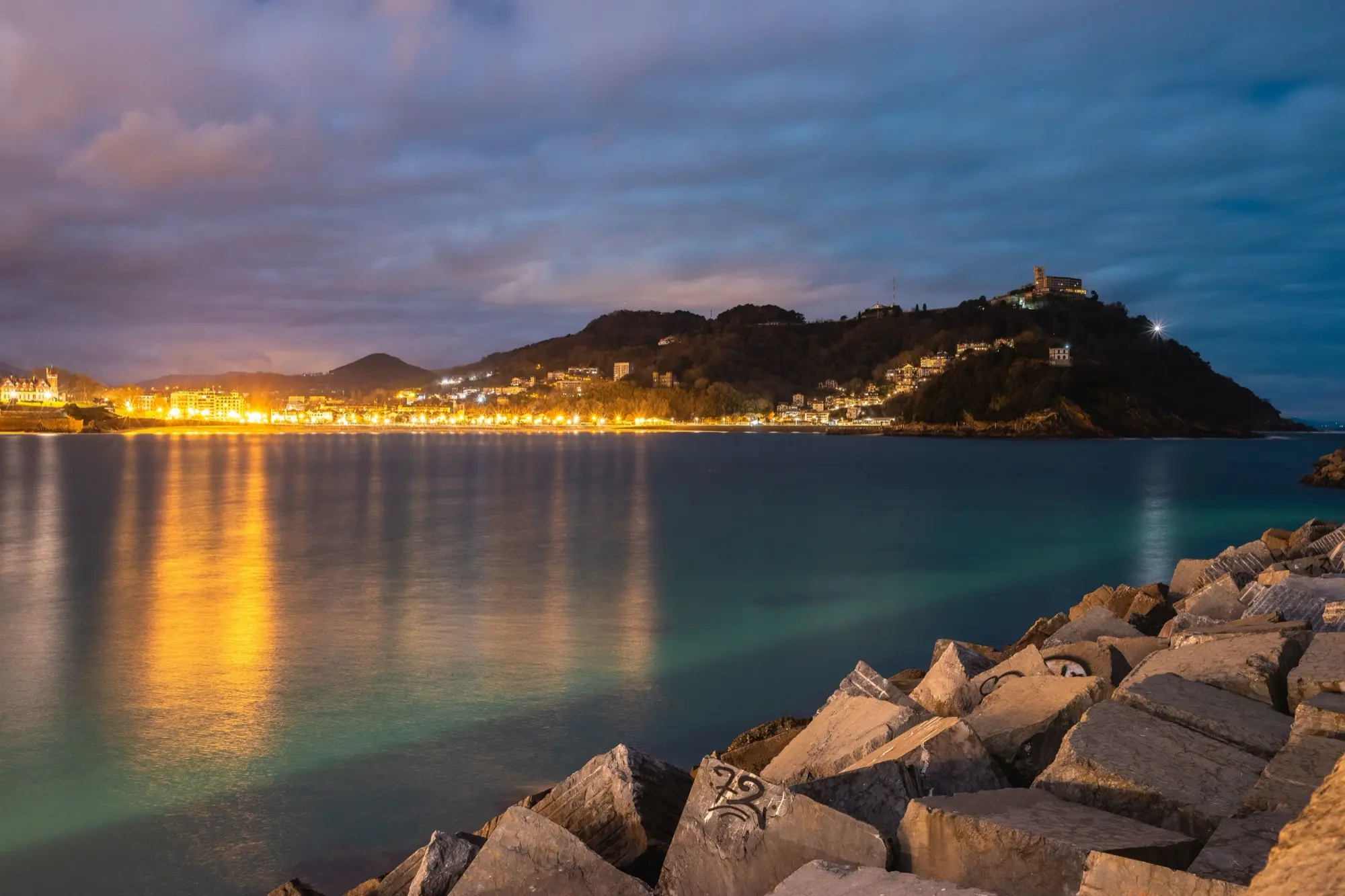
San Sebastián
San Sebastián is a summer city in a rainy climate: August is the busiest month (84), January the calmest (35), and rain falls on 11 to 15 days every month.
When to visit San Sebastián
San Sebastián is calmest in January and busiest in August. For the best balance of decent weather and smaller crowds, aim for February.
The official hotel occupancy series for Donostia-San Sebastián (INE, 2022 to 2025) puts January at 35 out of 100 on our crowd scale, July at 82 and August at 84. The beach and the old town are the draw, so the crowd follows the sun more than any holiday or festival.
The climate is Atlantic and wet all year. Highs go from 11 °C in January to 23 °C in August, and there are 15 rainy days in January and November against 11 from June to October. A quiet month is therefore also a wetter one, but summer is not dry either.
Weigh May, June, September and October against the peak. May has a crowd value of 66, highs of 18 °C and 13 rainy days; June has 71 and 21 °C; September 76 and 21 °C; October 69 and 19 °C with 11 rainy days. Winter, from December to March, runs at 35 to 49 with highs of 11 to 14 °C.
Book things to do
Tours and tickets in San Sebastián, from our booking partner.
 Free cancellation
 Free cancellation
 Free cancellation
 Free cancellation
 Free cancellation
Crowds month by month
Twelve months of San Sebastián at a glance — tap a month for the full picture.
Every month in San Sebastián
Weather, crowds and what’s on — one page per month.
Quietest month: San Sebastián in January
Weather through the year
Typical highs, lows and wet days.
Best day of the week
How the crowd moves through a typical week.
Tue is normally the calmest day of the week.
Best time of day
The daily rhythm, hour by hour.
The 9:00 AM window is usually the calmest of the day.
Where the crowd gathers
A typical peak afternoon in the centre.
How long to stay
Two days for the old town, the bay and Monte Igueldo; three or four if you add the coast and the surrounding area.
Local timing tips
- For beach weather with fewer people, June (71) and September (76) are calmer than July (82) and August (84), with highs of 21 °C in both.
- Pack for rain in any month: even from June to October there are 11 rainy days a month, so keep an indoor plan B.
- Spanish national holidays (1 and 6 January, Good Friday, 1 May, 15 August, 12 October, 1 November, 6 and 8 December and 25 December) may close some shops and venues; check opening hours around those dates.
- The crowd series is hotel overnight stays at the Donostia-San Sebastián tourist point (INE) and the climate comes from the Igueldo station, 5 km away; read both as the rhythm of the season, not as the queue at a given bar.
Where to stay
Outside peak season, nightly rates tend to be lower, and flexible dates help. Compare places to stay on Booking.com.
Frequently asked questions
When is the best time to visit San Sebastián?
The best time to visit San Sebastián is January, the quietest month of the year, or the shoulder weeks around February when the crowd eases but the weather still holds.
What is the cheapest and quietest month in San Sebastián?
January is the quietest month in San Sebastián, with a modelled crowd level near 35/100 and typical highs of 11°C.
When is San Sebastián most crowded?
San Sebastián peaks in August, when both visitor numbers and prices are at their highest.
How many days do you need in San Sebastián?
Two days for the old town, the bay and Monte Igueldo; three or four if you add the coast and the surrounding area.
Sources
Weather: 1995–2024 averages from the San Sebastián Igueldo weather station (NOAA GHCN-Daily); rain days count days with at least 1 mm.
Monthly crowd index: calculated from recorded overnight stays (table Encuesta de Ocupación Hotelera, tabla 2078 (pernoctaciones, puntos turísticos), 2022–2025; area: Donostia-San Sebastián tourist point), published byINE.
Crowd scores are modelled estimates, not live counts.How the model works
Events, holidays and practical notes are checked against these official pages:
Other attractions
Photo: Sonny Vermeer · Pexels