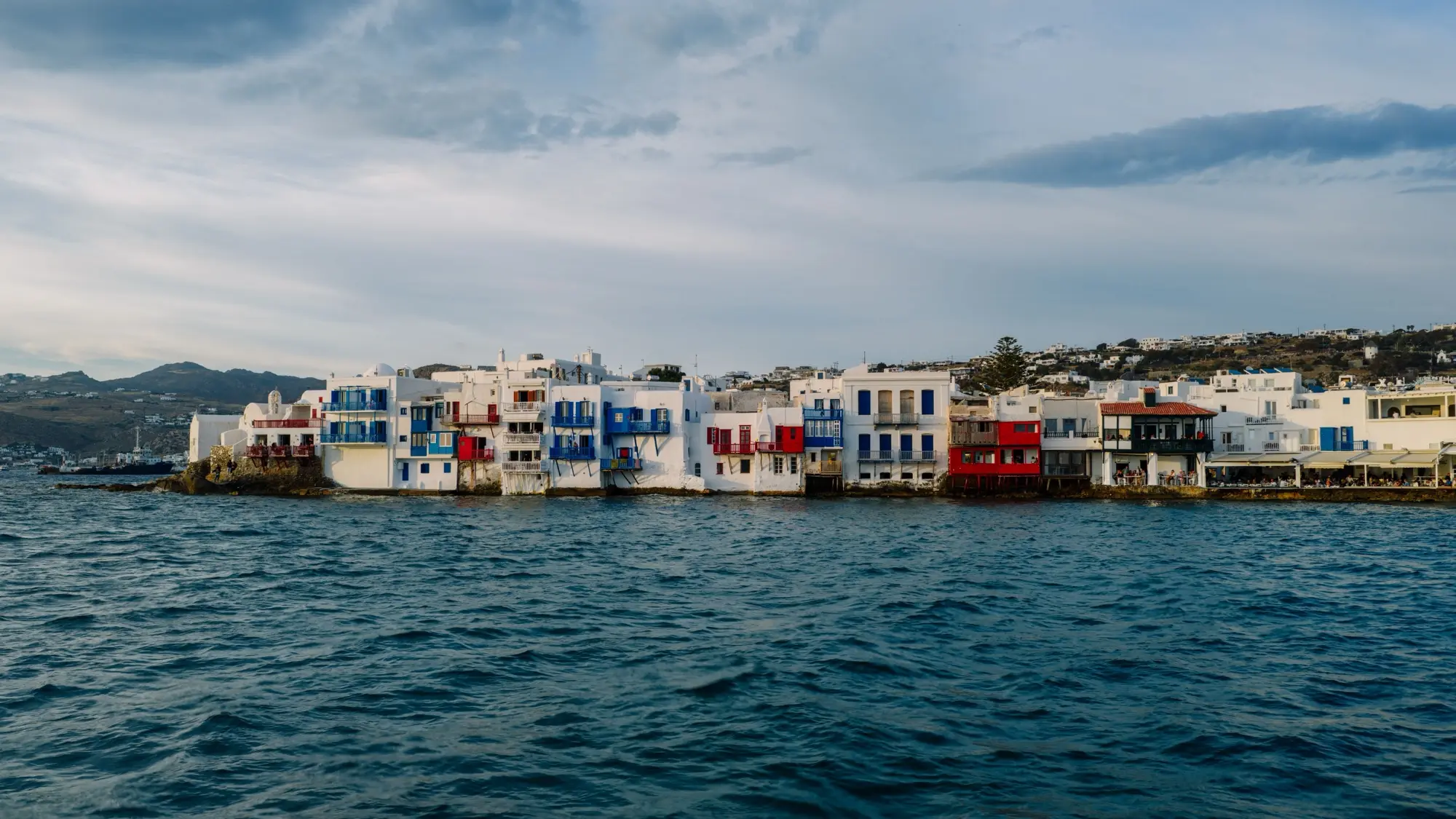
Mykonos
Mykonos is a summer island: June to September sit at the top of the crowd scale, and November to March at the bottom.
When to visit Mykonos
Mykonos is calmest in January and busiest in June. For the best balance of decent weather and smaller crowds, aim for February.
The regional overnight-stay series (South Aegean, EL42, Eurostat, 2022 to 2025) puts June, July, August and September at 98 out of 100 on our crowd scale and November to March at 8. There is no official monthly series for the island alone, so Mykonos uses the curve of the region.
April (30) is the first month that opens up, May (81) is busy but well below the summer, and October (58) is the last month with the season still running. Highs are modest for a Greek island, 19 °C in May, 25 °C in July and August and 20 °C in October; these come from modelled climate data, not from a weather station.
In winter the highs are 13 °C in January and February, with 12 rainy days in January and about ten hours of daylight, and much of the island’s hospitality is closed. Beach clubs, boat trips and many hotels follow the season, so confirm every booking, and check your ferry or boat operator for sea conditions on the day.
Book things to do
Tours and tickets in Mykonos, from our booking partner.
 Free cancellation
 Free cancellation
 Free cancellation
 Free cancellation
 Free cancellation
 Free cancellation
Crowds month by month
Twelve months of Mykonos at a glance — tap a month for the full picture.
Every month in Mykonos
Weather, crowds and what’s on — one page per month.
Quietest month: Mykonos in January
Weather through the year
Typical highs, lows and wet days.
Best day of the week
How the crowd moves through a typical week.
Tue is normally the calmest day of the week.
Best time of day
The daily rhythm, hour by hour.
The 9:00 AM window is usually the calmest of the day.
Where the crowd gathers
A typical peak afternoon in the centre.
How long to stay
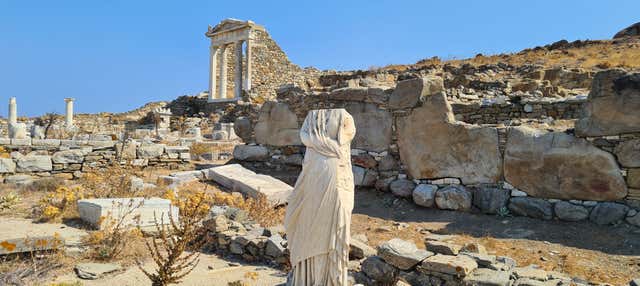
Two to three days for Mykonos Town, the beaches and one boat trip, a day more if you add Delos.
Local timing tips
- May and October are the months to weigh against the summer: crowd 81 and 58, against 98 from June to September; October has highs of 20 °C and 3 rainy days.
- From November to March expect closures: the regional series sits at 8 and many hotels, restaurants and boat services pause, so confirm what is open before you book.
- Public holidays (25 March, 1 May, 15 August, 28 October) and Orthodox Easter follow the Greek calendar, and Easter often falls on a different date from Western Easter; check the date for your year.
- The crowd curve is regional (South Aegean) and the climate figures are modelled, so treat both as the rhythm of the season and check ferry and flight timetables for your dates.
Where to stay
Outside peak season, nightly rates tend to be lower, and flexible dates help. Compare places to stay on Booking.com.
Frequently asked questions
When is the best time to visit Mykonos?
The best time to visit Mykonos is January, the quietest month of the year, or the shoulder weeks around February when the crowd eases but the weather still holds.
What is the cheapest and quietest month in Mykonos?
January is the quietest month in Mykonos, with a modelled crowd level near 8/100 and typical highs of 13°C.
When is Mykonos most crowded?
Mykonos peaks in June, when both visitor numbers and prices are at their highest.
How many days do you need in Mykonos?
Two to three days for Mykonos Town, the beaches and one boat trip, a day more if you add Delos.
Sources
Weather: 1995–2024 averages from the ERA5 climate reanalysis (Copernicus, via Open-Meteo); rain days count days with at least 1 mm.
Monthly crowd index: calculated from recorded overnight stays (table tour_occ_nin2m, 2022–2025; area: South Aegean (EL42)), published byEurostat.
Crowd scores are modelled estimates, not live counts.How the model works
Events, holidays and practical notes are checked against these official pages:
Other attractions


Photo: K · Pexels