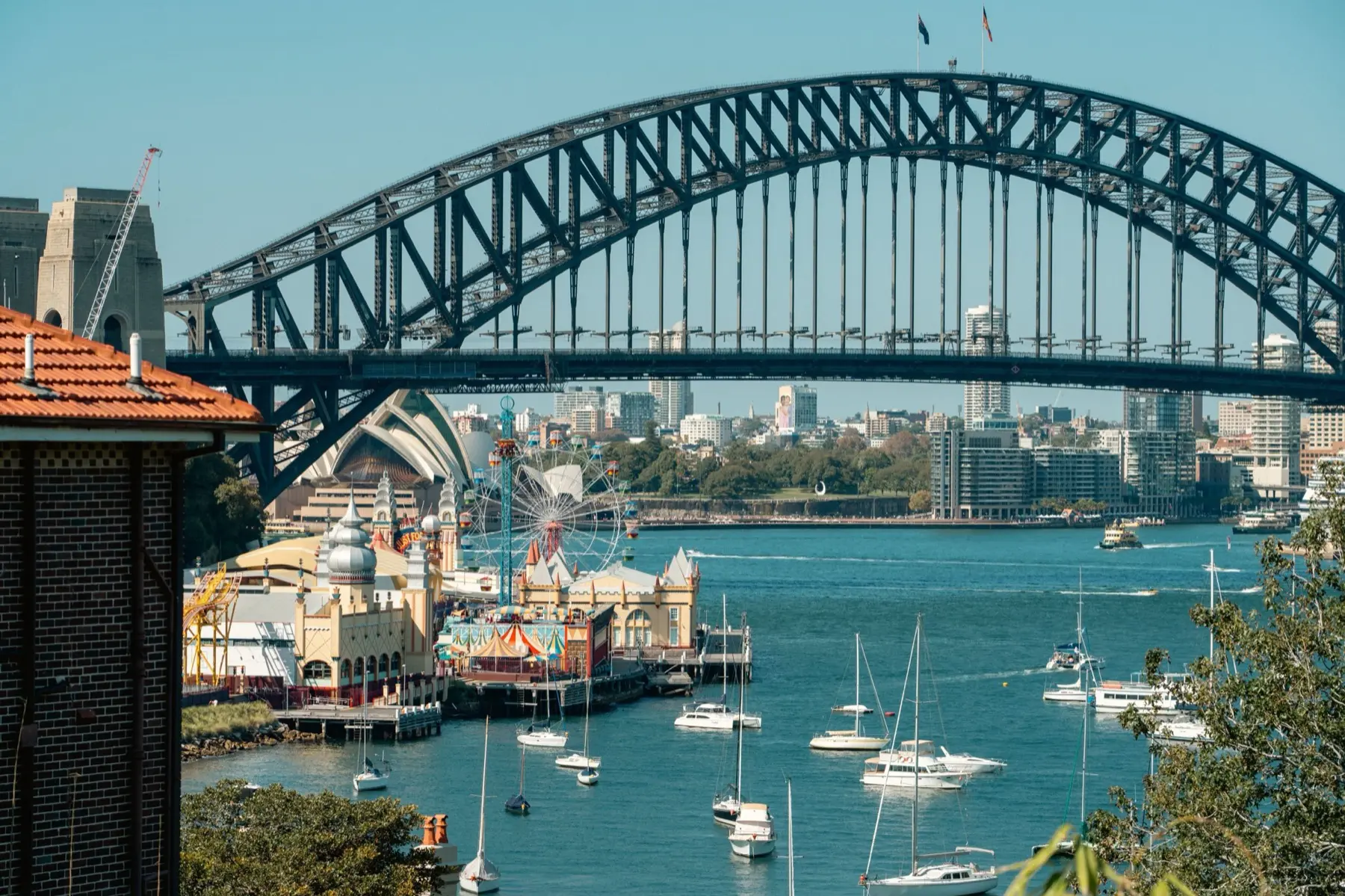
Sydney
December to February is the southern summer peak — August is mild and half the price.
When to visit Sydney
Sydney is calmest in August and busiest in January. For the best balance of decent weather and smaller crowds, aim for July.
Sydney peaks with the southern summer. December through February brings 26°C days, warm water, Australian school holidays from mid-December to late January, and the two events that define the city’s calendar — the New Year’s Eve fireworks on the harbour and the Sydney to Hobart start on Boxing Day. Accommodation around the harbour is priced accordingly and books out a year ahead for New Year.
The shoulder seasons are quietly better. March and April hold on to swimming weather with the holiday crowd gone, and September through November warms up again with jacarandas in bloom and whales passing the headlands. Rain is spread through the year rather than concentrated in a monsoon, so no month is a washout — March is statistically the wettest and still only around thirteen wet days.
Winter here is not really winter. June, July and August sit between 17 and 19°C with the clearest, driest air of the year, and the coastal walks are at their best. Vivid Sydney lights the harbour from late May into mid-June and pulls a genuine crowd, but outside that fortnight the city is at its cheapest, and the Opera House, the ferries and the Blue Mountains are all uncongested.
Book things to do
Tours and tickets in Sydney, from our booking partner.
Crowds month by month
Twelve months of Sydney at a glance — tap a month for the full picture.
Every month in Sydney
Weather, crowds and what’s on — one page per month.
Weather through the year
Typical highs, lows and wet days.
Best day of the week
How the crowd moves through a typical week.
Tue is normally the calmest day of the week.
Best time of day
The daily rhythm, hour by hour.
The 9:00 AM window is usually the calmest of the day.
Where the crowd gathers
A typical peak afternoon in the centre.
How long to stay
Four days for the city and the coast walks; six if you want the Blue Mountains and a night in the Hunter Valley.
Local timing tips
- The Manly ferry is ordinary public transport at a public-transport fare and gives you the same harbour views as the commercial cruises — just tap on with a contactless card.
- Walk Bondi to Coogee early: it takes about two hours one way, has almost no shade, and the UV here is severe even on cool days.
- Opal fares cap by day and by week, and the low Sunday cap makes a train trip to the Blue Mountains almost free.
- Surf beaches are only patrolled between the red and yellow flags — swim between them, and use the ocean pools at Bronte or Wylie’s when the swell is up.
Frequently asked questions
When is the best time to visit Sydney?
The best time to visit Sydney is August, the quietest month of the year, or the shoulder weeks around July when the crowd eases but the weather still holds.
What is the cheapest and quietest month in Sydney?
August is the quietest month in Sydney, with a modelled crowd level near 52/100 and typical highs of 19°C.
When is Sydney most crowded?
Sydney peaks in January, when both visitor numbers and prices are at their highest.
How many days do you need in Sydney?
Four days for the city and the coast walks; six if you want the Blue Mountains and a night in the Hunter Valley.
Photo: Donovan Kelly · Pexels